Unfulfilled Promise: Apple's Battery Woes for older devices

When the Apple Event of September 2023 approached, the tech world braced itself for groundbreaking revelations, and rightfully so. Among the most pressing concerns for Apple users was the vexing issue of battery life. Amidst the buzz and excitement, one conspicuous absence left many disillusioned: the glaring lack of substantial battery life improvements for Apple's flagship iPhone and Apple Watch series. In this article, we delve into the frustrations and implications of Apple's neglect of this crucial aspect of our digital lives.

Quest for Battery Life Enhancement
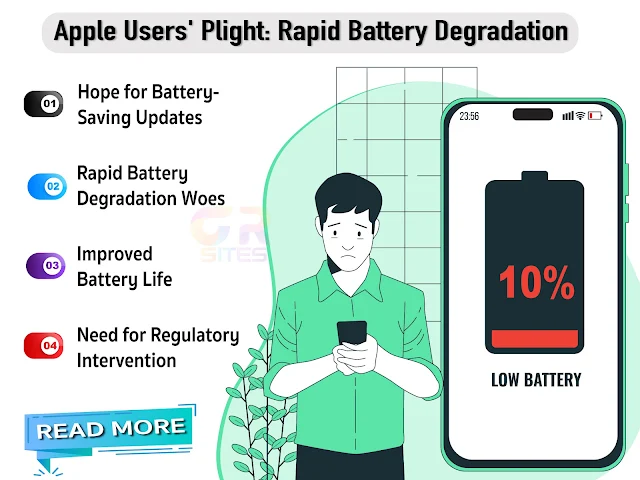
  • Apple User's Plight: Apple users, in particular, have faced this dilemma acutely. iPhones and Apple Watches, while beloved for their sleek design and cutting-edge features, have often left their users grappling with a common woe—rapid battery degradation.
  • Reality Check: However, as the event unfolded, the reality was far from the lofty expectations. Apple's focus seemed to be elsewhere, leading to a deep sense of disappointment among users.
  • Unfulfilled Hope: What many were hoping for was a software-level innovation that could counteract battery degradation. Such features have been introduced in the past, but this time around, the much-anticipated software wizardry remained elusive.
Apple's Battery Woes for older devices
Road Ahead
  • Making Voices Heard: Apple has a track record of not focusing on improving battery life in the older devices. At least some regulators should take a note of it and should force Apple to adhere to some base level battery performance. So, the device doesn’t get dropped of battery life rapidly and at least holds life for little, longer duration. 
  • Hope for Updates: Users can only hope that future updates, perhaps even iOS 17.1, will introduce the battery-saving features they've been longing for.
In conclusion, while the Apple Event of 2023 may have met the lofty expectations regarding new device announcements, the story doesn't end here. In the aftermath of the Apple Event in September 2023, the absence of significant battery enhancements for the iPhone and Apple Watch was a bitter pill to swallow. While we celebrate the strides Apple has made in various other areas, we can't help but yearn for a more substantial solution to the battery predicament. With each update and innovation, there's hope for a future where our devices stay powered longer, allowing us to navigate the digital realm with confidence. So, as we charge our iPhones and Apple Watches once more, we do so with the enduring hope that the next breakthrough in battery technology is just around the corner.

Navigating Childhood Myopia: A Parent's Guide to Clear Vision

Navigating Childhood Myopia: A Parent's Guide to Clear Vision
One fine day, my kid's teacher mentioned something that sent a chill down my spine. She casually remarked that my 5-year-old was having trouble viewing the board during class. My immediate reaction was to dismiss it as nothing more than a minor inconvenience—maybe a play of light or my child's momentary lack of focus. Little did I know that this innocuous comment would lead to a profound discovery about my child's vision.

Visit to the Ophthalmologist: Uncovering Myopia
  • Eye Assessment: At the ophthalmologist's office, my child underwent a comprehensive eye assessment. It was during this process that we got our first inkling that something might be amiss. The eye chart test revealed that my little one had difficulty reading the smaller letters, which were a blur.
  • Diagnosis: Myopia - The ophthalmologist confirmed our suspicions: myopia. While it was not an easy pill to swallow, it was the clarity I needed to understand why my child had been struggling. Myopia was the culprit behind those squints and classroom difficulties.
  • Importance of Early Detection: Early detection of myopia is crucial. The sooner you identify it, the more effectively you can manage its progression. Left unaddressed, myopia can lead to severe vision problems in the future. It's why that initial visit to the ophthalmologist became a turning point in our journey.
Understanding Childhood Myopia
  • A Growing Epidemic: Myopia's prevalence among children is on the rise globally. Factors like increased screen time, reduced outdoor activities, and genetic predisposition contribute to its growth. It's no longer an isolated issue; it's a widespread concern.
  • Progression Conundrum: What's especially concerning about childhood myopia is its progressive nature. Without intervention, myopia tends to worsen over time, increasing the risk of severe vision problems later in life. This is precisely why early detection and management are critical.
Managing Childhood Myopia
  • Role of Corrective Lenses: One of the most common ways to manage childhood myopia is through corrective lenses, typically eyeglasses or contact lenses. These lenses help your child see clearly and more comfortably.
  • Myopia Control Measures: In recent years, various myopia control methods have emerged. These interventions aim to slow down the progression of myopia in children. Some options include atropine eye drops, multifocal contact lenses offered by Essilor – Stellest, Zeiss Myocare, etc., and orthokeratology.
  • Lifestyle Adjustments: Encouraging outdoor play, limiting screen time, and ensuring good lighting conditions for reading are simple yet effective lifestyle adjustments that can complement other myopia management strategies.
Conclusion: Nurturing Clear Vision and Bright Futures
Discovering myopia in my child was initially unsettling, but it led to a journey of understanding and proactive management. Childhood myopia is a growing concern, but with early detection, the right interventions, and parental support, we can ensure that our children see clearly and embrace bright futures. Remember, as a parent, you play a pivotal role in safeguarding your child's vision. So, stay vigilant, be informed, and together, we can navigate the path to clear vision.

Finding Peace with the Healing Power of Time

Finding Peace with the Healing Power of Time
Life is full of ups and downs, and it's not uncommon to encounter situations that leave us feeling disgruntled, hurt, or overwhelmed. Whether it's a painful breakup, an unexpected accident, or the intentional actions of someone close to us, these experiences can shake us to our core. These experiences can weigh heavily on our hearts and minds, leaving us searching for solace and healing. However, amidst the chaos, there is one constant that can help heal our wounds and restore our sense of peace: time. Time has the remarkable ability to mend wounds, soothe sorrows, and bring about a sense of renewal.

Embracing the Gruntled Mindset
  • Turmoil of Life's Challenges: When we find ourselves in the midst of distressing situations, it can be easy to succumb to negative emotions and allow them to consume us. However, embracing a gruntled mindset involves acknowledging our emotions, accepting the circumstances, and consciously choosing to focus on healing and growth. 
  • Power of Time: Time, as the saying goes, heals all emotional & personal wounds. It is an invaluable resource that allows us to process our emotions, gain new perspectives, and ultimately find healing and peace. While it may seem like an eternity when we're amid a difficult situation, the passage of time offers a sense of clarity and distance that allows us to navigate through life's challenges with renewed strength and resilience.
Finding Healing through Time
  • Granting Yourself the Gift of Time: In a world that often demands instant results and immediate resolutions, it is crucial to remember the importance of granting ourselves the gift of time. Healing cannot be rushed; it requires patience and understanding. By allowing ourselves the space to heal, we create an environment where transformation can take place organically, without the pressure of unrealistic expectations.
  • Allowing Yourself to Feel: Just as a physical wound requires time to heal, so do emotional wounds. Time acts as a soothing balm, gradually easing the pain and allowing us to process our emotions. As we grant ourselves the space and time to heal, we begin to gain perspective, develop resilience, and find inner strength. It is during this healing process that we can emerge stronger, wiser, and more compassionate.
  • Embracing Self-Care: During challenging times, self-care becomes even more crucial. Take the time to engage in activities that bring you joy and comfort. Whether it's spending time in nature, practicing mindfulness and meditation, or engaging in creative outlets, nurturing yourself allows the healing process to unfold more smoothly. Engaging in activities that bring us joy, practicing mindfulness and meditation, and seeking support from loved ones can all contribute to our overall healing journey.
  • Gaining Perspective and Growth: As time passes, we often gain new perspectives and insights into the events that caused our distress. This newfound clarity helps us understand the lessons learned and the personal growth that has taken place. Remember that every challenge presents an opportunity for growth, and time allows us to fully embrace these transformations.
  • Cultivating Gratitude: Gratitude is a powerful tool for healing. Take a moment each day to reflect on the things you are grateful for, even amidst the difficulties. This practice helps shift our focus from what went wrong to the blessings and positive aspects of our lives, creating a sense of peace and contentment.
My final thoughts: 
In the face of life's adversities, it is natural to feel disgruntled and overwhelmed. However, as we navigate the challenges that come our way, we must remember the power of time. Time acts as an ultimate healer, allowing us to find solace, gain perspective, and grow from our experiences. So, the next time you find yourself burdened by the weight of pain, remember this: time has a way of healing everything.