Tuesday, September 15, 2026
Starlink India Plans vs Fibre: The Real Cost
The fibre guy has been saying next month for two years. Your phone shows four bars of 5G on the terrace and nothing in the back bedroom. So you start reading about Starlink India plans, and somewhere around the third forum thread it becomes clear that nobody is comparing the thing that decides it, which is what a full year costs against a wire you cannot actually get.
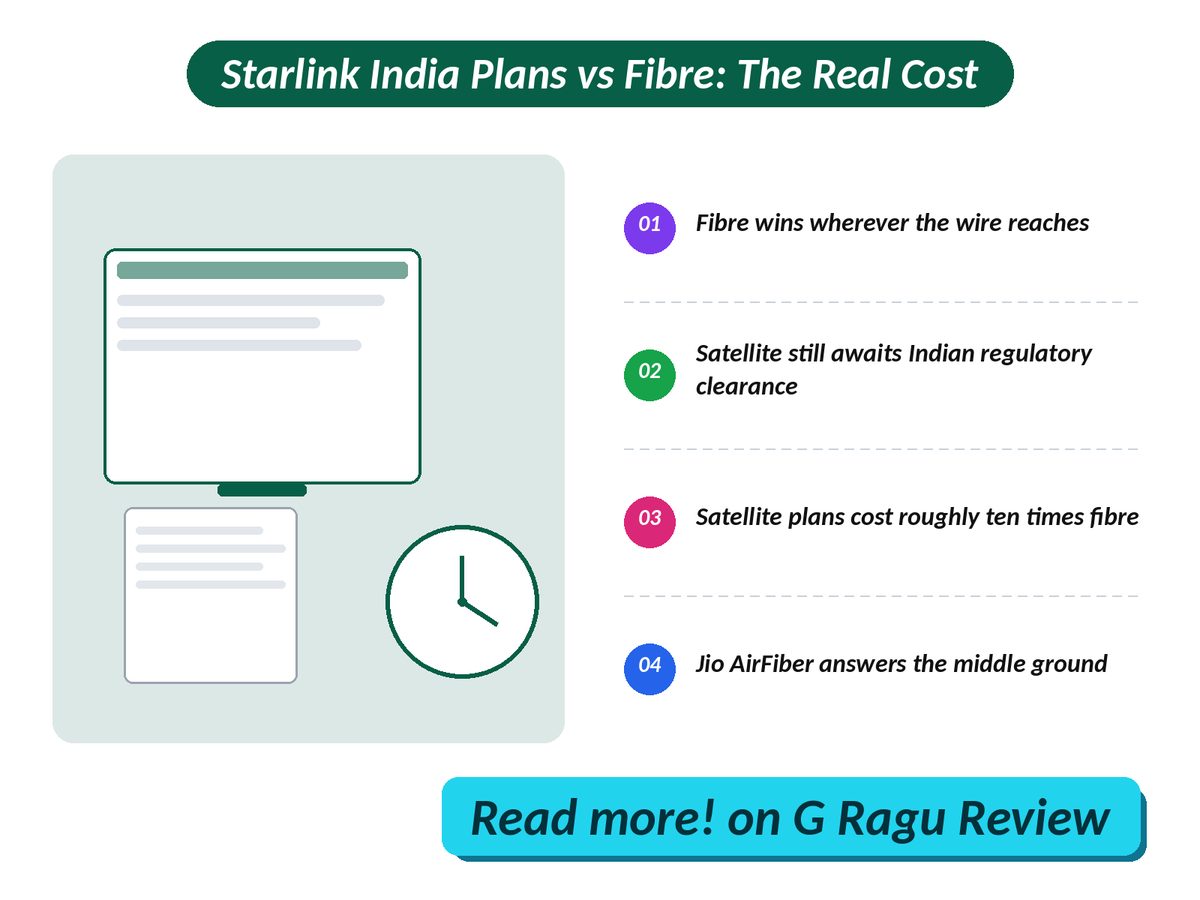
TL;DR: Fibre wins wherever it reaches, fixed wireless wins the middle, and satellite is for the addresses neither one ever got to.
- Satellite is not commercially open in India yet. Clearances still sit ahead of it.
- The listed satellite price is roughly ten times a comparable wired plan, before any hardware is counted.
- Jio AirFiber, not fibre, is the realistic answer for most homes the wire skipped.
- Buy the dish only when no provider will commit to a date and indoor 5G fails a call.
Is Starlink Available In India Yet?
Not commercially, no: Starlink holds an Indian licence and has ground stations planned, but the satcom spectrum framework only cleared the Digital Communications Commission in September 2026, with Cabinet approval and security clearances still ahead of it.
That approval, reported by The Hans India on 9 September 2026, settled how satellite operators will be charged and left the calendar blank. Cabinet sign-off comes next, then security demonstrations, and Starlink, Amazon's Kuiper and Jio's own satellite arm are queued behind the same gate. The framework also dropped the separate per-subscriber urban levy the regulator had proposed, on the practical ground that nobody could reliably tell an urban subscriber from a rural one. Meanwhile the thing you are buying bandwidth for keeps getting hungrier, and a surprising share of it is what your smart TV quietly reports back over that connection.
Here is the number that explains why anyone cares. TRAI's June 2026 subscriber report counts 5.15 million rural wireline connections against 42.68 million urban ones. The wire went to the cities and largely stopped there. That gap is the real addressable market for satellite broadband in India, and it is not a rounding error. What it is not is a market for satellite at the price that briefly appeared last December.
Wired broadband lines
47.71 million
TRAI count, June 2026
Speed ceiling floated
200 Mbps
Ministry position, July 2025
Trial window offered
30 days
Starlink listing, December 2025
Satcom spectrum levy
5% of revenue
4% when serving rural areas
Set the national wireline count beside the billion-plus broadband connections India actually carries and the shape of the problem stops being subtle. Fewer than one connection in twenty in this country is a wire. Everything else is a radio. That is why a dish on the roof reads as exotic here while a 5G box on the windowsill does not, and it is why the honest comparison for satellite was never fibre in the first place. Most households are buying a pipe for video anyway, increasingly for the free ad-supported apps that now out-watch paid subscriptions, and those need steadiness far more than they need a headline speed.
Satellite broadband in India is not competing with fibre. It is competing with having nothing at all, and against nothing it wins without trying.
What Starlink India Plans Cost Against Fibre
About an order of magnitude more per month before any hardware is counted, and that gap holds across every tier because the satellite price barely moves with speed while wired and fixed-wireless plans get cheaper per megabit as you climb.
One caveat before the table, and it matters. Starlink showed Indian residential pricing on its own site in December 2025, then called the figure a technical glitch within hours, after the Economic Times had reported a far lower band of Rs 2,500 to Rs 3,500. Business Standard covered both versions on 10 December 2025. So the satellite column is a listing, not a tariff. My own read is that it will not survive contact with a market where the alternatives are this cheap, and the grey area is how far it falls: a price that clears in Ladakh is a different number from one that clears in Lucknow, and the company has said nothing useful about which it is aiming at. Treat the column as a ceiling.
| Dimension | Starlink | Airtel Xstream Fiber | Jio AirFiber |
|---|---|---|---|
| Monthly | Rs 8,600 as listed | Rs 799 at 100 Mbps | Rs 899 at 100 Mbps |
| Up front | Rs 34,000 kit, not refundable | Free install, router included | Rs 1,500 to Rs 2,500, refundable |
| Data | Unlimited on the listed plan | Unlimited, no stated cap | 1 TB, then 64 Kbps |
| Speed | 190 to 360 Mbps in nearby markets | 40 Mbps to 1 Gbps tiers | 30 Mbps to 1 Gbps tiers |
| Reach | Ground stations planned in 6 cities | Only where the lane is already cabled | 5,800 plus towns |
| Today | Not selling, clearances pending | Selling now | Selling now |
| Payback | Kit alone equals 42 months of fibre | Baseline for the comparison | Kit equals 38 months of AirFiber |
| Best suited for | Addresses with no wire and no usable 5G | Any street the cable already reaches | Towns with 5G but no fibre |
Two rows carry the argument. The payback row is arithmetic anyone can redo: divide the kit by the monthly fibre bill and the box alone costs three and a half years of service before a single byte moves. The reach row is the counterweight, and it is the only one that can overturn the verdict, because a plan you cannot order is worth nothing however cheap it is.
Derived here from the monthly prices in the table above, Airtel's published plan page and Starlink's listed Indian pricing. Operator figures are quoted before GST where the operator lists them that way, and the refundable AirFiber deposit is excluded.
Is Satellite Internet Worth It If Fibre Reaches You?
No, not if a wire already terminates at your building, because satellite costs more, delivers less headroom and adds a failure mode you cannot fix from inside the house, leaving redundancy as the only honest case.
Capacity is the part that never appears on a comparison page. A single constellation might support only 10,000 to 20,000 connections in a city the size of Delhi, because the beams are shared and the sky over a metro is the same sky for everyone underneath it. September's framework dropped the explicit subscriber caps that had been floated earlier, which sounds like good news for buyers in cities. It is not, or it stops being good news the moment you notice that dropping a rule does not add a single beam overhead. Satellite in dense areas gets rationed by queue and by price whether or not a regulation says so, and the places that need it least are the places that will bid hardest for it.
Then there is what the connection feels like rather than what it measures. Satellite adds a round trip to orbit on every request, which barely shows in a speed test and shows immediately in a video call, a game, or a live stream that keeps rebuffering at the worst possible second. Anyone who has argued about why 60 FPS matters more than 4K for a live match already knows the principle: delivery consistency beats peak numbers, every time. Rain fade is the other one. A dish in a Kerala monsoon is not the same product as a dish in Leh, and no brochure will tell you that.
Four things to check before you put money down:
- Ask your wired provider for a written installation date, not a verbal one, and ask twice across two months.
- Test indoor 5G in the room you actually work in, at the hour you actually work, not on the terrace at noon.
- Read the fair-usage line, because a 1 TB cap that drops you to 64 Kbps is a different product from genuinely unlimited.
- Price the hardware as a sunk cost, since a refundable deposit and a purchased dish are not comparable commitments.
Buy the dish only when all three are true.
- No wired provider will commit to a date at your address, and you have asked more than once.
- Indoor 5G fails a video call in the room where the work happens, on a weekday, not a Sunday morning.
- The connection earns its keep, or someone other than you is paying the first-year bill.
So do this before the end of the week: open your provider's app, request a written fibre or AirFiber feasibility check at your exact address, and put the reply in a folder. That single reply decides which column above you belong in, and it costs nothing. If the answer comes back no on both, you are the customer satellite was built for, and the wait is worth it. If it comes back yes, spend the money on the other end of the chain instead, starting with the panel spec that actually changes how live sport looks.
Related: choosing between a Wi-Fi 7 router vs mesh for whole-home coverage