Wednesday, October 21, 2026
TV Antenna vs YouTube TV: What $83 Buys You
- Published
- 10:54 PM
- Author
- Comments
- 0
Every month the same charge lands for a household that mostly watches local news, Sunday football and whatever Netflix suggests next. Two ways to get those local channels compete for that money: an antenna stuck to a window, or YouTube TV streaming them. Framed as TV antenna vs YouTube TV, it sounds like a gadget question. It is really about what the bill buys that the air hands out free.
Key Takeaways
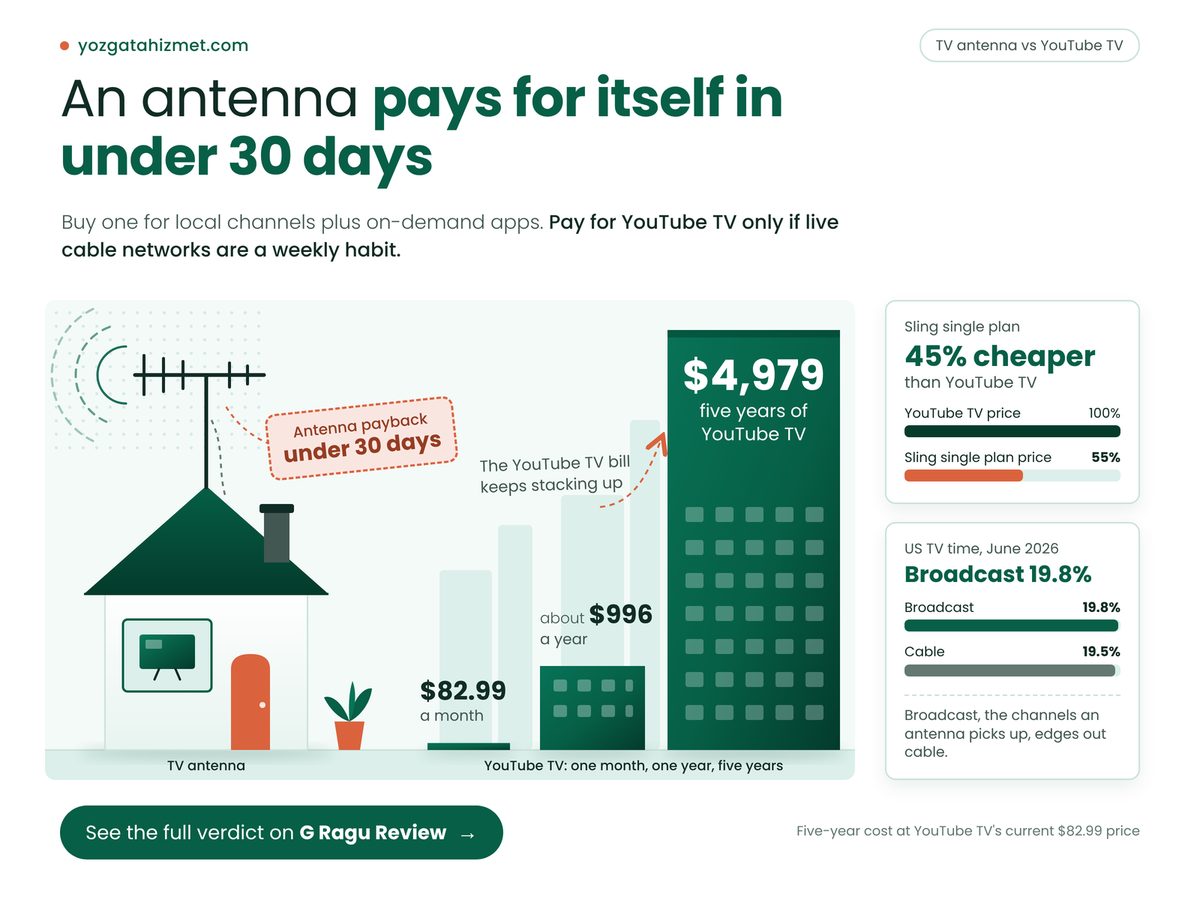
Buy an antenna for local channels plus on-demand apps; pay for YouTube TV only if live cable networks are a weekly habit.
- A year of YouTube TV costs about $996, while an antenna's locals cost nothing after purchase.
- Sling's cheaper plans mostly skip ABC and CBS, so they need an antenna too.
- Nielsen's June 2026 count put free broadcast TV ahead of all cable in US viewing time.
- Check the FCC's DTV Reception Maps first: reception, not price, is the antenna's real risk.
Is an antenna better than YouTube TV?
An antenna brings in ABC, CBS, NBC and Fox with no monthly bill, while YouTube TV charges full price for those same networks plus cable, so it is better whenever cable is not something you watch.
Clark Howard's live TV price guide, updated in January 2026, lists YouTube TV at $82.99 a month with the major local networks included, so an antenna only has to cost less than one month of service to pay for itself. Switching bundles does not help: the same guide puts Hulu + Live TV at $89.99 and DirecTV's Choice package at $94.99, more money for the same locals. Sling's Orange or Blue plan is $46, but it largely skips ABC and CBS, so it still needs an antenna.
Most cord-cutting guides still treat YouTube TV as the safe default, and I think that advice is out of date, or at least out of date for anyone whose week is mostly local channels. It is the most polished way to rent channels already in the air above your house. Drop it, and the TV's home screen becomes your front door, so check which home screen shows fewer ads, Roku or Google TV, and why a new smart TV sells ads before you watch anything.
Worked from those January 2026 prices, these four numbers carry the decision, because each is a cost or a wait a household actually feels.
Dearest Bundle, One Year
$1,140
Derived; paying for free channels
Antenna Payback Time
Under 30 days
Derived; if it costs under one bill
Local Networks YouTube TV Resells
4 networks
All free over the air nearby
Sling Single Plan vs YouTube TV
45% cheaper
Derived; still needs an antenna
The payback card is the one to remember. It holds for any antenna you pick: a one-time purchase smaller than a single month of streaming is repaid before the next charge, and every later month stays in your budget.
The dearest bundle charges over a thousand dollars a year for networks that arrive through the air for nothing.
Now the sum worth doing with your own bill: divide your monthly live TV charge by four. If ABC, CBS, NBC and Fox are what you actually watch, that is your per-network price, the number to hold against any antenna on a shelf.
TV antenna vs YouTube TV: the five-year math
Over five years, the gap between a one-time antenna purchase and a monthly YouTube TV bill grows into thousands of dollars, so the deciding question shifts from what each costs to what you actually watch.
The five-year figure is my own arithmetic: sixty bills at today's price, no further increase, which flatters YouTube TV.
| You weigh | Antenna vs YouTube TV | What it means for you |
|---|---|---|
| 🧾 Monthly bill | Antenna $0 after setup YouTube TV 12 bills a year |
✅ Ends the recurring charge |
| 💰 Five-year cost | Antenna One purchase YouTube TV $4,979 at current price |
✅ Keeps thousands yours |
| 💰 Price rises | Antenna Fixed once bought YouTube TV Raised 2024 and 2025 |
❌ Expect the bill to climb |
| 📊 Channels | Antenna Locals in range YouTube TV Locals plus cable |
⚠️ Extra spend buys cable |
| 🏁 Best suited for | Antenna Locals plus apps YouTube TV Weekly cable viewing |
🏁 Match last week's viewing |
The channel row decides it. Did anyone here watch a cable network live last week? If not, the extra money buys nothing you use.
Nielsen's The Gauge for June 2026, as MediaPost reported it, credits YouTube alone with 13.5% of US TV time and Netflix with 7.9%, so on-demand apps carry streaming and an antenna plus one or two apps matches how people actually watch. A year earlier cable held 23.4% and broadcast 18.5%: cable is the shrinking slice that YouTube TV's extra money buys.
Free broadcast TV now draws slightly more US viewing than all cable combined, so dropping a live bundle mostly gives up cable, not the main event. Source: MediaPost on Nielsen's The Gauge, June 2026, the last edition before a method change.
Where does an antenna fall short?
An antenna falls short wherever the signal does: homes far from broadcast towers or tucked behind hills may get some networks weakly or not at all, and no saving makes up for a missing channel.
So check first. The FCC's DTV Reception Maps page takes your address and lists the stations you should receive, colour-coded by signal strength. That check turns the antenna plan from a guess into a yes or no.
Streaming fails differently. WRDW's November 2025 streaming guide notes that carriage disputes cause temporary blackouts on YouTube TV and Hulu, so you can pay in full and still lose a local network mid-season. A bundle is also only as steady as your Wi-Fi, so check whether a Wi-Fi 7 router or mesh fixes dead zones before blaming the service.
One open question, and this is opinion. The same MediaPost report says Nielsen is recalibrating The Gauge from the 2026-27 season using ARF DASH universe estimates (an industry count of how homes watch), and analysts expect streaming to look less dominant. Broadcast's lead over cable is thin; I would not bet a subscription on it. An antenna does not hide your viewing either, so learn how smart TVs track what you watch and the setting that stops it.
- Indoor antennas are fussy about placement, so try more than one window before returning one.
- Games on ESPN or a regional sports channel never reach an antenna.
Cancel the live bundle if all four are true
- The FCC map shows your local stations as strong or moderate.
- Nobody watched a cable-only channel live last week.
- Your must-watch sport airs on ABC, CBS, NBC or Fox.
- Your TV's input menu lists an Antenna or Air source.
So the antenna wins for any home whose week is local channels plus an app or two, and YouTube TV wins only where live cable is a weekly habit. This week, run your address through the FCC's map, buy an antenna from a store with easy returns and test it before your next billing date. If the locals come in clean, cancel.
No comments
Post a Comment